For those of us who find mowing a chore each season, a robot lawnmower promises to theoretically end that task and give you back hours of free time. However, there’s a fair bit of set-up to get this robot up to speed
Don’t believe the hype without doing a bit of research. After all, these can be more expensive than even the most expensive conventional push lawnmower.
What are robot lawnmowers?
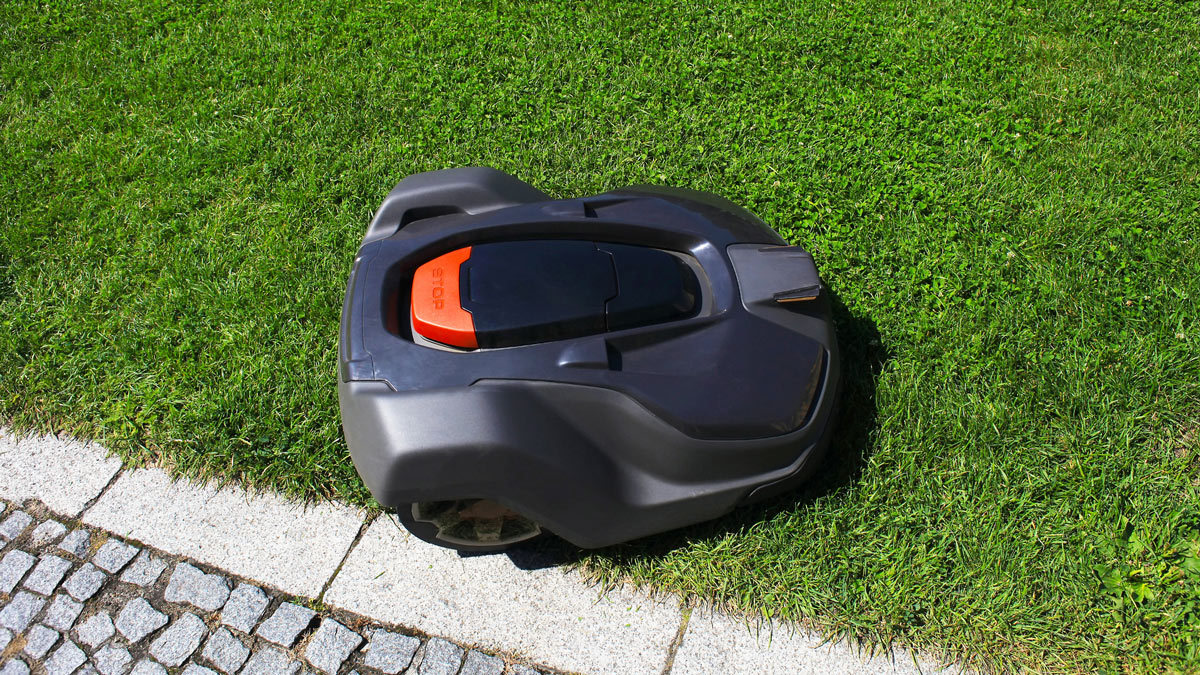
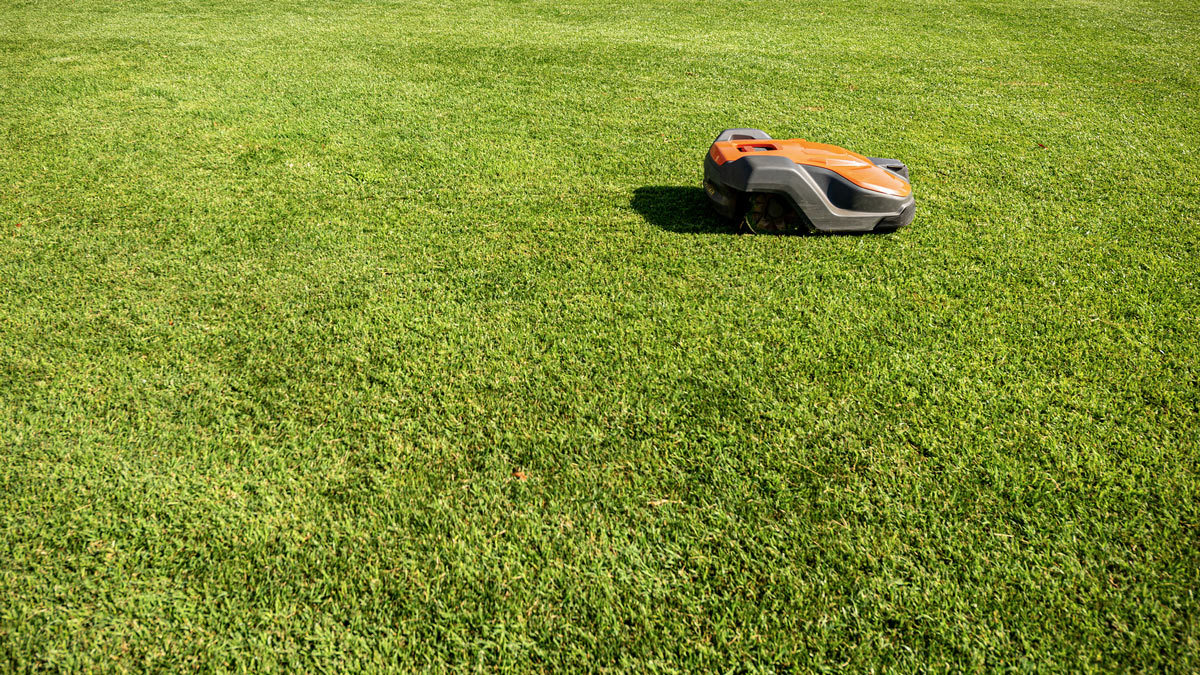
Much smaller than a conventional lawnmower, the robot mower is a reasonably automated lawnmower that is battery operated. There’s no catcher, as a robot mower cuts the lawn fine enough to leave the grass on the lawn.
They’re expensive compared to most conventional lawnmowers – some can equal the cost of a ride-on mower. They’re suitable for lawns up to 5000 square metres (sqm), but all require a little bit of set-up to get to their reasonably autonomous state.
Most robot mowers will come with the main cutting unit, a charging dock and a guard wire. The guard wire is used to set the perimeter of the area it will be mowing. In order to get your mower up and running, there are a few steps you’ll need to take.
Install the guard wire
Most robot lawnmowers will come
with a guard wire, which is used to
set the perimeter of the area it will
be mowing. This allows your mower
to detect the edges of your
lawn. You’ll need to
set up the guard
wire using the
supplied pegs,
although some
manufacturers
will allow you
to hide the wire
under the soil (some
manufacturers can even
do this for you). Either way,
the wire is not too noticeable,
so shouldn’t be an eyesore once
it’s installed.
The guard wire connects to the
charging unit, so it can guide itself
back to the charging unit. This means
you’ll have to place the charging dock
close to an electrical outlet.
Set up the app
Once the guard wire is installed,
many robot lawnmowers can be
set up through an app on your phone,
or on the mower itself. You’ll need to
set up a schedule for the robot mower
so it knows when to start cutting.
Prepare your yard
Remove any moveable obstacles,
such as toys dropped by children
or pets. If you’re starting off with
long, overgrown grass, you might
need to use a normal lawnmower
to get the grass down to a shorter
length before you start on your
robot lawnmower journey. Robot
lawnmowers only have so much
oomph, so there are limits to the
length of the grass they can cut.
Monitor the first mow
You’ll need to monitor the mower’s
progress to make sure it isn’t getting
stuck anywhere, and check that
it reaches all parts of your lawn.
From that point on, it should be fairly
autonomous – at least until you need
to replace the batteries or have the
blades sharpened or replaced.
How loud is a robot lawnmower?
Unless you’re very close to the robot lawnmower, you’re unlikely to be annoyed by the noise. They tend to reach around 60dB which is the equivalent of a conversation – there are some which can reach 70dB (a loud conversation) which is reflected in the scores of our robot lawnmowers test.
However, these sounds are when you’re very close to the mower – equivalent to a battery mower. A standard petrol mower is much noisier and can reach up to 80dB, which is the point where hearing protection is recommended.
You’re unlikely to be so close to a robot lawnmower as it goes about its business so it’ll come across as very quiet most of the time.
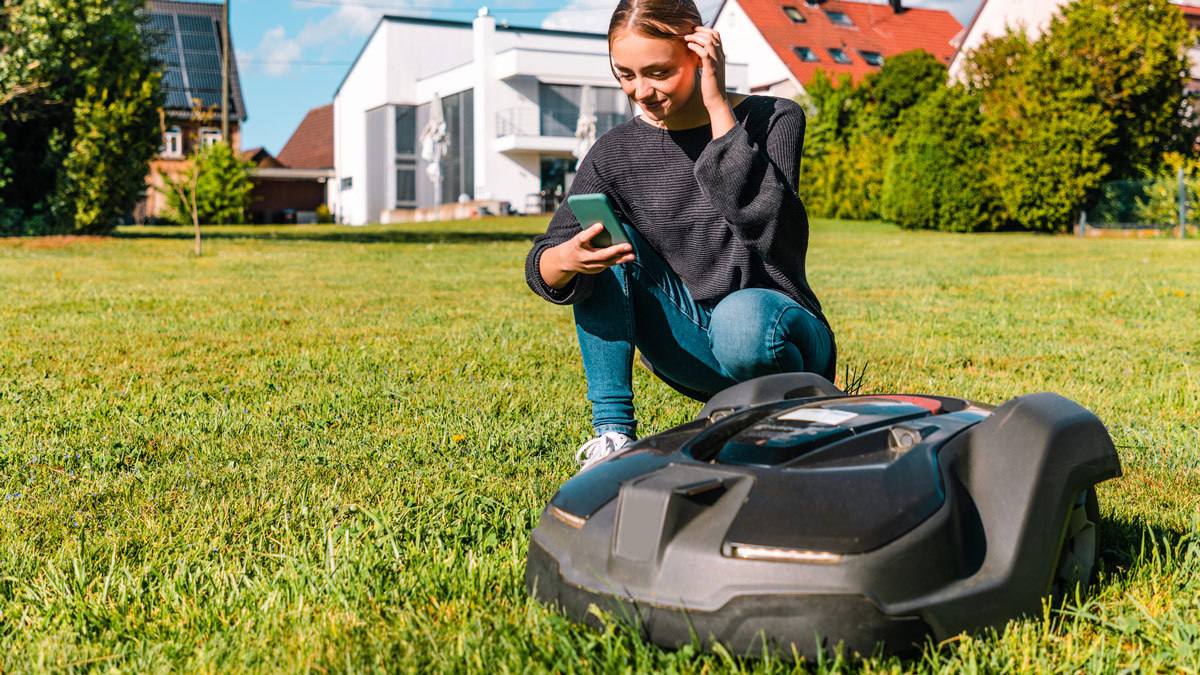
Many robot lawnmowers allow you to control them with an app on your phone.
What to look for in a robot lawnmower?
Smartphone app
In most cases it will
be easier to control the mower via an
app (if it has one) than fiddling with onboard controls.
But it really depends on how autonomous the robot mower is.
Some apps will let you set up a map of your garden so the mower knows where
to go rather than moving in a random fashion. Some can also let you see whether the robot mower is currently in action.
In previous testing we’ve found
that some apps will only work with
either Apple or Android phones,
but not both. All the apps for the models in our review work with both phone types, but if you’re looking at a different model it’s
worth checking the app compatibility before you buy. Other apps might
use Bluetooth rather than Wi-Fi to connect to the mower, which means you’ll need to be close to the robot mower to connect to it.
We’ve seen robot mowers suitable
for lawns of up to 5000sqm and
as small as 250sqm. The maximum stated capacity of a robot mower we’ve tested was 3000sqm.
If you select a robot lawnmower that’s designed for a smaller yard than what you have, you’re likely to run out of guard wire, or the mower
is going to run out of puff and need
to return to charge before finishing the job. Generally, manufacturers recommend buying one that’s suitable for a yard a little larger
than your own.
Slopes and uneven lawns
If your lawn is on a slope, it’s important to work out the angle and make sure the model you buy can cope with it – the maximum slope they can handle should be stated in the specifications.
An uneven lawn means dips, and not all mowers handle these equally (we test this as part of performance). If the dip is significant, you might consider fillingit in or putting a barrier around it and buying a model with obstacle sensors so it can avoid it. Also, the flatter your lawn, the more likely the mower is to be able to make a full round on one battery.
Sensors
Obstacle sensors
Most robot mowers have sensors for anything they encounter (all models in our review have in-built obstacle sensors).
If you have trees, bushes or other obstacles that can’t be removed before the lawnmower starts, it will avoid these elements, just as a robot vac would in the house.
Rain sensors
A rain sensor can be
an optional extra or may come with the product by default. Depending
on the brand and model, it might make the robot lawnmower skip
a scheduled mow, or it might alert
you and ask if you want to continue.
Multi-zone
Want your robot lawnmower to
mow both the front and back lawns? You might need a multi-zone mower, so you can program both lawn
sizes and designs. You’ll have to
carry or wheel the robot lawnmower between the two spaces, as they aren’t smart enough to move themselves there – yet.
Battery life
The most expensive element
of any mower will be the battery,
and the size you require will depend on the size of the lawn you want it
to cover.
All the models we’ve tested use lithium-ion batteries. Check with
the manufacturer before buying
to see how long they’ll stock the batteries for and the cost to replace (replacements can be expensive).
Like with all lithium-ion batteries, you’ll start to see slow degradation over time – the robot mower will
start returning to its base unit
more frequently for recharging.
You can expect batteries for robot mowers to last at least two to five years, depending on environmental conditions such as heat and cold during use and storage, how often the mower is run and what time of day it generally cuts the grass.
Each manufacturer will instruct you not to leave pets or children near the robot lawnmower, whether in use or not. There are plenty of built-in safety features for robot lawnmowers, but follow the guidelines regardless.
Even though we haven’t seen a documented case of a pet’s tail getting cut or robot lawnmowers climbing up a shoe, there’s no reason to tempt fate.
How much do robot lawnmowers cost?
Robot mowers are generally more expensive than the average battery or petrol mower, but this is dependent on their feature set and battery size. You can expect to pay around $1000 and up, stretching into tens of thousands of dollars.
The most expensive robot mower we tested covers up to 2000sqm and costs $3999, whereas the cheapest is $999 and only covers 700sqm. This is enough to cover a small house block.
Are robot lawnmowers more sustainable than petrol lawnmowers?
Robot mowers are more sustainable than petrol models, but only when you’re looking at direct emissions. Petrol mowers emit more, but it’s a similar argument to electric cars – if you’re getting your electricity from coal, then that may offset some of those emissions you’re saving. Then include the rare metal extraction included in the lithium ion battery and the fact that you’ll have to replace it at some point in the next several years, and you might narrow the margin on overall emissions.
We haven’t done the full Life Cycle Assessment to tell whether robot lawnmowers are more sustainable than petrol lawnmowers, but battery lawnmowers are getting much more popular, so we expect these to pick up the pace of ownership for smaller yards over time.
Matthew Steen is the Director of Reviews and testing, which conducts all the testing content for CHOICE. He has worked for CHOICE for more than 20 years, from customer service to testing and content production.
Matthew is driven to work at CHOICE for its mission, and the people that it attracts, from staff to members, all dedicated to making Australia more fair, safe and just.
Matthew represents CHOICE as a council member on the Standards Australia Council. He is also responsible for ensuring CHOICE stays carbon neutral.
Matthew has a Bachelor of Humanities in Ethics from Queensland University of Technology.
Find Matthew on LinkedIn.
Matthew Steen is the Director of Reviews and testing, which conducts all the testing content for CHOICE. He has worked for CHOICE for more than 20 years, from customer service to testing and content production.
Matthew is driven to work at CHOICE for its mission, and the people that it attracts, from staff to members, all dedicated to making Australia more fair, safe and just.
Matthew represents CHOICE as a council member on the Standards Australia Council. He is also responsible for ensuring CHOICE stays carbon neutral.
Matthew has a Bachelor of Humanities in Ethics from Queensland University of Technology.
Find Matthew on LinkedIn.
For more than 60 years, we've been making a difference for Australian consumers. In that time, we've never taken ads or sponsorship.
Instead we're funded by members who value expert reviews and independent product testing.
With no self-interest behind our advice, you don't just buy smarter, you get the answers that you need.
You know without hesitation what's safe for you and your family. And our recent sunscreens test showed just how important it is to keep business claims in check.
So you'll never be alone when something goes wrong or a business treats you unfairly.