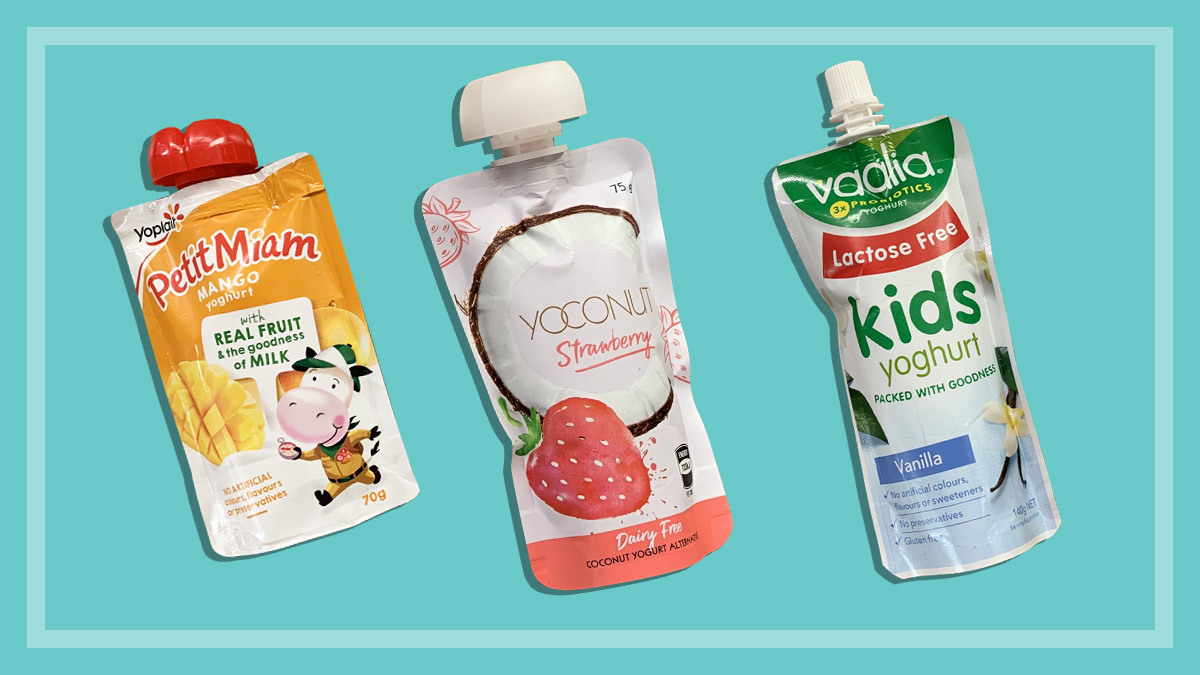
Squeezy pouches of yoghurt are a common sight in lunchboxes – a favourite of parents needing a convenient snack to feed their children when they’re out and about.
They’re also extremely popular with kids who love the novelty of sucking on the spout and not having to bother with a spoon.
But are they healthy?
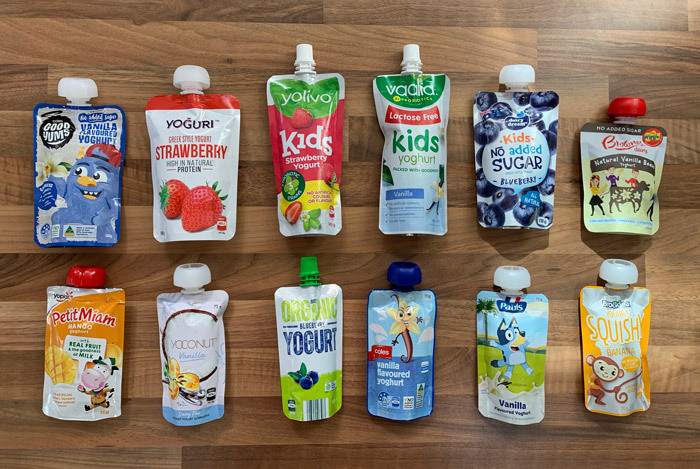
We took 118 different squeezy yoghurt products from brands including Yoplait Petit Miam, Chobani, Tamar Valley Kids and Farmers Union. We then reviewed their ingredients and calculated their Health Star Ratings.
You could certainly do worse than a yoghurt pouch when it comes to a nutritious snack for your child. But before you stock the fridge with enough to give out on a daily basis, here are some things about squeezy yoghurt pouches to keep in mind.
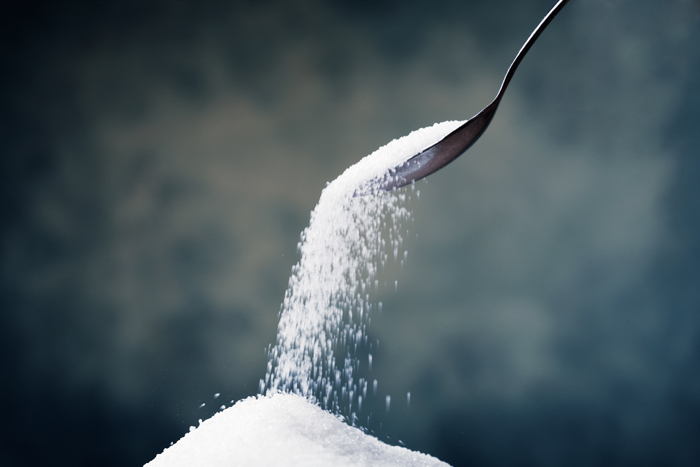
Three in five of the products we reviewed contain added sugar.
Does it contain added sugar?
When we first reviewed squeezy yoghurt pouches in 2016, all the ones we looked at contained added sugar.
The good news is there’s been a small improvement – now, about three in five (64%) of the products we reviewed contain added sugar, mostly in the form of sugar, fruit-juice concentrate or rice syrup. That means about two in five contain no added sugar.
If the total sugars value on the nutrition information panel is more than 7g per 100g, it probably contains added sugars
Most squeezy yoghurts still don’t list added sugar in the nutritional information panel, so it’s difficult to tell how much of the sugar content is added vs intrinsic (naturally occurring sugars found in milk, fruit and vegies).
But, on average, natural yoghurt contains roughly five to six percent intrinsic sugars. So if the total sugars value on the product’s nutrition information panel is more than 7g per 100g, it probably contains added sugars.
What are added sugars?
Added sugars are the major source of sugar in the Australian diet and are damaging to our health.
The World Health Organization (WHO) calls added sugars “free sugars”. These include monosaccharides such as glucose and disaccharides such as sucrose, which are added to foods and beverages by the manufacturer, cook or consumer – on top of the sugars naturally present already in honey, syrups, fruit juices and fruit-juice concentrates.
The World Health Organization (WHO) calls added sugars “free sugars”.
When we say “added sugars”, we’re referring to WHO’s definition of free sugars.
(See our guide to added sugar for more information.)
Why you need to watch out for carrot concentrate
We also found that 17 products contained black-carrot or purple-carrot concentrate.
It’s reasonable to assume that the inclusion of carrot would make a yoghurt healthier, but carrot concentrate is basically just the colour and sugars, not the fibre and other nutrients in a whole carrot.
Squeezy yoghurts that contain the most sugar
Of the 118 yoghurts we reviewed, the following 10 (ordered alphabetically) contain the most sugar – all had 12g or more per 100g:
Aldi Just Organic Yogurt (70g pouch: vanilla bean, strawberry, blueberry; 140g pouch: vanilla bean, strawberry)
Aldi Yoguri Greek Style High Protein Yogurt (strawberry)
Chobani (blueberry, strawberry)
Coles Yoghurt Pouch (blueberry)
Five:am Organic (vanilla bean)
For total sugars, Aldi’s Just Organic vanilla bean yoghurt was the worst offender, with 15.4g of sugars per 100g. That’s more than ten times more sugar than a pouch of vanilla Cocobella Dairy Free Coconut Yoghurt (1.2g/100g). The sugars they contain may be organic, but that doesn’t make them healthy.
Is it a good source of calcium?
A product is a “good source of calcium” if a serving contains no less than 25% of the recommended dietary intake (RDI) for that mineral, according to the Food Standards Code (FSC).
Calcium is a major health drawcard for yoghurts. But we found wide variations in the amount the squeezy products contain – from about 100mg per 100g (Chobani) up to 296mg per 100g (Pauls Birthday Cake Flavoured Yoghurt Pouch).
We found wide variations in the amount of calcium the squeezy products contain
Of the dairy-free products we looked at, only Cocobella stated its calcium content of 113mg per 100g.
The RDI of calcium for children aged four to eight is 700mg a day. We found 51 products that contain 175mg calcium or more in each pouch, making them a good source of calcium, according to the FSC.
Squeezy yoghurts that are a good source of calcium
These yoghurt pouches contain more than 175mg calcium per serve (ordered alphabetically):
If the yoghurt contains 175mg calcium or more in each pouch, it’s a good source of calcium for kids aged 4–8.
Is it a good source of protein?
If you’re looking for a yoghurt pouch with high protein, we found that all the products with ‘high protein’ claims on the packaging contain 10g or more of protein per serve – so are a good source, according to the FSC.
Some of the yoghurt pouches have “source of protein” or “protein for growing bodies” claims on the packaging. While this is accurate – they all contain protein – they may not necessarily be a ‘good’ source.
If the amount of protein is important to you, check the nutritional information panel, as we found that 60 products contained less than half the amount of protein to qualify as a good source, as defined by the FSC.
Squeezy yoghurts that are a good source of protein
(In alphabetical order)
Aldi Yoguri Greek Style High Protein Yogurt (strawberry)
Fat is what makes yoghurt thick and creamy. But a high-fat yoghurt also means it’s high in saturated fat, which we’re supposed to eat less of (although yoghurts with reduced-fat milks aren’t suitable for children under the age of two).
Low-fat yoghurts contain more calcium, on average, than those with a higher fat content
For a yoghurt to be considered low-fat, it should have no more than 3g fat per 100g. Of the products we looked at, three in five (62%) met the low-fat definition.
For calcium enthusiasts, low-fat yoghurts contain more calcium, on average, than those with a higher fat content.
Squeezy yoghurts that are low in fat
(Ordered alphabetically.)
Aldi Brooklea No Added Sugar Yogurt Pouch (banana, strawberry)
Yoplait Petit Miam (strawberry, blueberry, vanilla, mango, fruit salad, banana)
Less fruity than you hoped?
Don’t be surprised if the fruit content of your yoghurt doesn’t live up to the pictures on the label.
Some yoghurts do seem to be flavoured with minimally processed real fruit. But the fruit content in others is more like a kind of jam made from fruit purée, water and sugar, with thickeners, colours and food acids.
The fruit content in some yoghurts is more like a kind of jam
You can only tell by looking closely at the ingredients list: if it’s not real fruit, you’ll see something like ‘fruit’ followed by sugar and other ingredients, all enclosed within brackets.
Text-only accessible version
Your at-a-glance guide of things to consider when choosing the right yoghurt pouch for your kids.
Added sugar
Natural yoghurt on average contains roughly five to six percent intrinsic sugars, so if the total sugars value on the nutrition information panel is more than 7g per 100g, the yoghurt probably contains added sugars.
Carrot concentrate
This is basically just the colour and sugars, not the fibre and other nutrients that are in a whole carrot.
Fruit content
Look at the fruit content in the ingredients list. If you see something like “fruit” followed by sugar and other ingredients, all enclosed within brackets, it’s likely to be a kind of fruit jam rather than whole or minimally processed fruit.
Calcium
For four-to-eight year-olds, a “good” source of calcium equates to at least 175mg per serve of food.
Protein
For a yoghurt to be a “good” source of protein, it must contain 10g or more of protein per serve.
Low-fat
Low-fat products must contain no more than 3g fat per 100g.
Health Star Ratings
We did our own calculations* to check the Health Star Ratings (HSR) of the yoghurt pouches that displayed them (about 11% of those in our survey). All of them were accurate.
According to our calculations, the following 21 products have an HSR of 5:
Chobani (vanilla, raspberry, pineapple coconut)
Chobani FIT (coconut, vanilla, blueberry, strawberry, raspberry, banana)
*We calculated HSRs using information from the ingredients lists and data in the nutrition information panel. We assumed 0g fibre unless the panel said otherwise (it’s not mandatory to label fibre content).
Additives in yoghurt
Many yoghurt products contain additives, and squeezy yoghurts – for the most part – are no exception. You’ll see them listed, usually as a number, in the ingredients list. Examples include:
Thickeners and stabilisers
These make the yoghurts taste creamy and prevent separation: pectin (440), vegetable gums (406, 410, 415) and starch (1442).
Acidity regulators
These stop the yoghurt becoming too acidic (300, 330, 331, 296).
Colours and flavours
Which are all “natural”, according to the squeezy yoghurts in our review.
‘Vanilla’ doesn’t always mean ‘vanilla bean’
All the “vanilla bean”-flavoured yoghurts we looked at contain actual vanilla bean.
But if you want a vanilla-flavoured yoghurt to actually contain vanilla bean, we recommend you look closely at the ingredients list.
Despite most vanilla-flavoured yoghurts showing a picture of a vanilla bean on the packet, only five of those we looked at (Aldi Yoconut Coconut Yogurt, Activia Probiotics, Cocobella Dairy Free Coconut Yoghurt, Chobani Fit and Danone Yopro) contain actual vanilla bean, ranging from less than 0.1% to 1%. The rest just use ‘flavour’.
Natural yoghurt hard to beat
If you’re after great nutrition, and want to avoid unnecessary added sugars and additives, it’s hard to beat regular natural yoghurt.
Natural yoghurt from the supermarket will contain two basic ingredients: milk and live yoghurt cultures.
Of the 118 kids’ squeezy yoghurts we looked at, only two were natural:
Farmers Union Greek Style Yoghurt Pouch
Rafferty’s Garden
Alternatively, you can buy it in 500g or 1kg containers, meaning a comparable serving works out at a fraction of the cost. Topping it with chopped fruit will not only add sweetness, but also the nutritional benefits of whole fruits.
You could also pour natural yoghurt into reusable squeezy pouches for an easy snack on the go – slightly less convenient than the supermarket versions, but a good option if you want to cut down your plastic waste.
Not all yoghurt pouches are created equal, but you could certainly do worse when it comes to a choosing a nutritious snack for your child.
Probiotics – don’t believe the hype
Probiotics (live ‘friendly’ bacteria) such as Lactobacillus acidophilus, Bifidus and Lactobacillus casei are often added to yoghurt.
Although probiotics can be beneficial for gut health in principle, many products don’t list the number of live cultures on the packaging – so there’s no guarantee that these squeezy yoghurts contain enough of the right bacteria that can survive in the yoghurt then go on to colonise the gut itself.
Even when a product does state the number of probiotics, it only refers to the amount added at the time of production – the number that survives will depend on how the product is stored and whether it’s exposed to air, light or moisture.
Two in five (41%) of the squeezy yoghurts we reviewed are gluten-free, and still more don’t include gluten or gluten-containing ingredients in their ingredients lists.
Vegan/vegetarian
We looked at the ingredients lists and any claims on the packaging to find out which products are suitable for vegans and vegetarians.
The majority of yoghurts we reviewed (90%) are suitable for vegetarians. Just watch out for animal-derived gelatine in the ingredients list.
Country of origin
Of the 118 products we looked at, 86 contained 90% or more Australian ingredients.
Only one product contained no Australian ingredients: Coyo Organic, which was “Made in Australia from imported ingredients”.
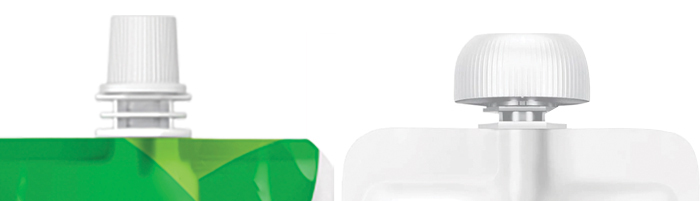
Yoghurt lids are choking hazards when removed from the pouch.
Choking-hazard lids
We found that two different types of screw-top lids were used on the yoghurts – a larger ‘mushroom’-shaped lid and a smaller screw-top lid similar to those found on some toothpastes.
No matter which lid your yoghurt has, both are choking hazards when removed from the pouch and should be kept out of the mouths of children. Three in five (62%) of the products we looked at had a choking warning on the packaging.
Marianna worked at CHOICE from 2017–2022, writing and editing content on a range of different consumer issues as both a content editor and commissioning editor.
She's conducted in-house taste tests for non-alcoholic wines, uncovered which is the best reusable water bottle, looked at the amount of sweet ingredients in infant foods, and analysed the contents of chocolate variety boxes to find out which are best for caramel lovers, fruit-goo fans and more.
She previously worked for a range of publications in both Australia and the UK including the BBC's Radio Times, The Guardian, The Sun, The Sunday Telegraph and Cosmopolitan.
You can find her on LinkedIn.
Marianna worked at CHOICE from 2017–2022, writing and editing content on a range of different consumer issues as both a content editor and commissioning editor.
She's conducted in-house taste tests for non-alcoholic wines, uncovered which is the best reusable water bottle, looked at the amount of sweet ingredients in infant foods, and analysed the contents of chocolate variety boxes to find out which are best for caramel lovers, fruit-goo fans and more.
She previously worked for a range of publications in both Australia and the UK including the BBC's Radio Times, The Guardian, The Sun, The Sunday Telegraph and Cosmopolitan.
You can find her on LinkedIn.
Rachel Clemons is an award-winning journalist who worked at CHOICE from 2004–2022.
During her time at CHOICE her core focus was on food and nutrition, from reviewing breakfast cereals and fast food to dispelling myths about the benefits of detox kits and gourmet salt or translating confusing food labels – with the occasional taste test thrown in for good measure.
Prior to CHOICE she lived overseas, working predominantly in hospitality when she wasn't travelling and eating her way through various cuisines. She holds a Master of Science in Nutrition from King's College London (where she also researched and wrote for CHOICE's UK sister organisation, Which?), and a Bachelor of Science, Health Sciences from the University of Adelaide.
In 2017 she won the Dietitians Association of Australia's Nutrition Journalism Award and she's currently on the Steering Committee as a Parent Member of Parents' Voice.
You can find her on Twitter and LinkedIn.
Rachel Clemons is an award-winning journalist who worked at CHOICE from 2004–2022.
During her time at CHOICE her core focus was on food and nutrition, from reviewing breakfast cereals and fast food to dispelling myths about the benefits of detox kits and gourmet salt or translating confusing food labels – with the occasional taste test thrown in for good measure.
Prior to CHOICE she lived overseas, working predominantly in hospitality when she wasn't travelling and eating her way through various cuisines. She holds a Master of Science in Nutrition from King's College London (where she also researched and wrote for CHOICE's UK sister organisation, Which?), and a Bachelor of Science, Health Sciences from the University of Adelaide.
In 2017 she won the Dietitians Association of Australia's Nutrition Journalism Award and she's currently on the Steering Committee as a Parent Member of Parents' Voice.
You can find her on Twitter and LinkedIn.
For more than 60 years, we've been making a difference for Australian consumers. In that time, we've never taken ads or sponsorship.
Instead we're funded by members who value expert reviews and independent product testing.
With no self-interest behind our advice, you don't just buy smarter, you get the answers that you need.
You know without hesitation what's safe for you and your family. And our recent sunscreens test showed just how important it is to keep business claims in check.
So you'll never be alone when something goes wrong or a business treats you unfairly.