We all know the dreaded microwave moment when food explodes and splatters all over the inside (especially if you’ve ever used one to cook or reheat a whole egg).
Apart from being unsightly and unhygienic, food remnants in your microwave can increase cooking times because they absorb some of the microwave energy. They may even shorten your oven’s lifespan. Luckily, it’s not that hard to clean and maintain your microwave using readily available, natural household ingredients.
How often should you clean your microwave oven?
This depends on how often you use it, but you should give your microwave a wipe every few days to avoid food residue building up. At the very least, make sure any spills are immediately removed with a damp cloth.
A handy tip is to wipe the interior down with a microfibre cloth immediately after cooking steamy foods such as vegetables and rice, as the sides will be warm and damp. Make sure you reach into the corners, too.
Apart from cleaning the inside using the quick microwave cleaning method, it’s important to clean away food that may accumulate in cracks and crevices.
1. Clean the turntable (if you have one)
Soup or other liquid may also make its way onto the glass turntable, and this can be removed for cleaning in your regular sink or dishwasher (if it’s small enough to fit – check to make sure it’s dishwasher safe first).
Check under the turntable where the spindle is and make sure any residue is also wiped away.
The removable turntable ring, or support (which sits underneath the turntable and guides it around) should also be removed and checked to make sure the wheels are clean and can move freely. If required, it can be washed with mild detergent and warm water.
2. Wipe the exterior
To clean the microwave exterior you’ll just need a warm, damp cloth in a mild solution of soapy water. See your microwave instruction manual for any specific precautions.
Generally, you should never use abrasive cleaning products or scourers inside or outside the microwave, as these can cause permanent damage.
3. Clean off greasy residue
For tougher, harder stains that don’t respond to warm soapy water, make a paste with water and bicarb soda, and scrub gently with a non-scratch sponge.
4. Check door frames, dials and buttons
Make sure doors seal properly and gunk doesn’t build up around buttons or seals. Anything that’s made its way into cracks or crevices may need a soft toothbrush, cotton bud or toothpick to gently prise away any hard foods, but take care not to rub or scratch the surface as this may damage it. Never use anything metal and make sure the microwave is unplugged before you start.
5. Clean the sides, top and back of the microwave
Over time, dust may accumulate on the microwave vents, making them less efficient. You may not notice this if the microwave doesn’t sit on your benchtop. Grease and grime may also gather on the top of your microwave over time. It may be necessary to unplug it and give it a good wipe over once in a while.
Gently wipe around the microwave with a soft, damp cloth.
What about cleaning convection microwave ovens?
You can use the steam-cleaning method in a convection microwave oven to wipe the interior down (including the grill element). However, baked-on fatty foods can splash onto the interior walls (which are usually stainless steel) and the glass door, and this food may be harder to remove.
To avoid build-up, make sure the oven is wiped with a cloth and mild soapy water after each use (as soon as the oven’s had a chance to cool down enough for you to reach in). Wipe in the direction of the grain if the walls are stainless steel. You can remove residue that’s extra hard to remove by using a paste made with bicarb soda and water, then scrubbing with a non-scratch sponge.
How do you get rid of microwave smells?
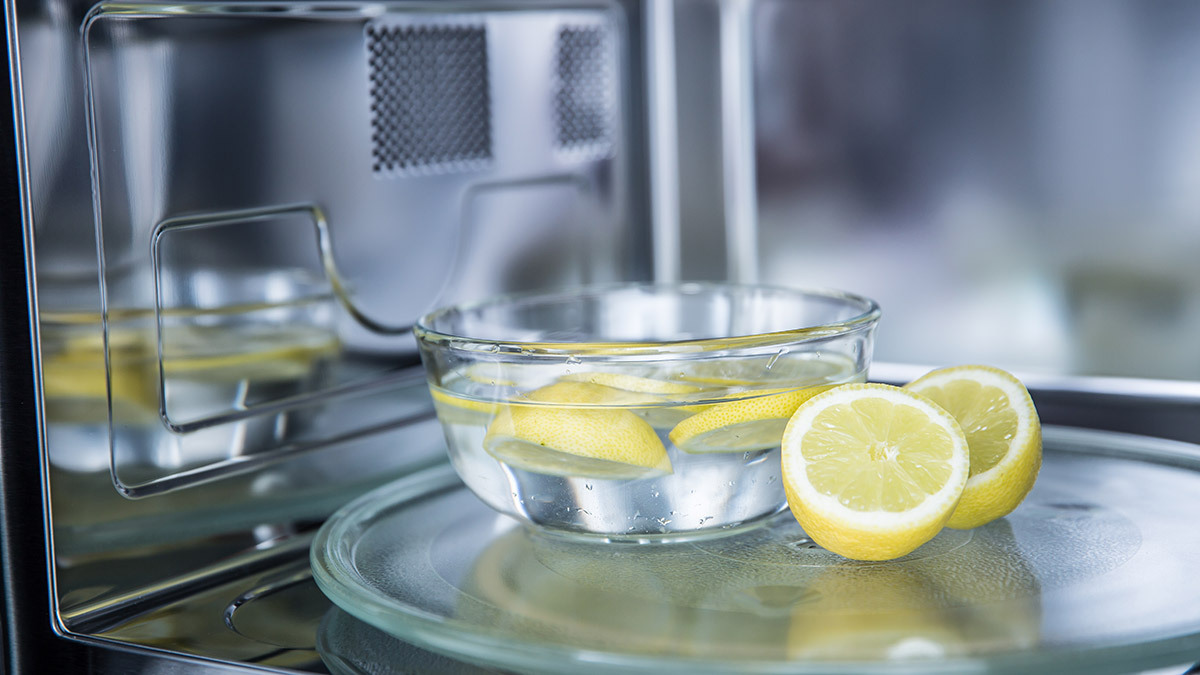
While lemon and vinegar can obliterate smells from your microwave, the scent can be quite overpowering.
Vanilla extract is also a food-safe way to leave your microwave smelling fresh. You can mix one or two teaspoons in a spray bottle filled with water. Spray it onto a cloth, wipe over the interior, leave for a few minutes, and wipe dry with a paper towel.
Alternatively, combine a cup of water and a teaspoon of vanilla extract in the microwave and heat it for a minute or so. Don’t leave the microwave unattended when you’re doing this.
Easy-to-clean microwaves
In the CHOICE kitchen lab, ease of cleaning is an important factor when our experts assess a microwave oven’s ease of use. When buying a microwave, look for one with sealed touch controls and fewer crevices on its outside surfaces. You may also want to consider models with no turntable (known as flatbed microwaves), as they’re easier to wipe out.
Kim Gilmour is a Senior project officer. She manages a range of product tests such as coffee machines, stick vacuums, bassinets, high chairs and ovens, which are all tested in our in-house labs.
Kim’s work gives people access to robust, independent advice and helps consumers make informed decisions about their purchases. Her work also helps to keep manufacturers in check, by regularly exposing product flaws which can result in better and safer products.
Prior to CHOICE, Kim spent 16 years working as a technology journalist in Sydney and London. With several years as a senior researcher/writer at our UK sister organisation, Which?.
Kim has authored how-to technology books such as Spotify for Dummies and Digital Photography for the Older and Wiser.
Kim has a Bachelor of Arts in Communication (Journalism) from Charles Sturt University.
Find Kim on LinkedIn.
Kim Gilmour is a Senior project officer. She manages a range of product tests such as coffee machines, stick vacuums, bassinets, high chairs and ovens, which are all tested in our in-house labs.
Kim’s work gives people access to robust, independent advice and helps consumers make informed decisions about their purchases. Her work also helps to keep manufacturers in check, by regularly exposing product flaws which can result in better and safer products.
Prior to CHOICE, Kim spent 16 years working as a technology journalist in Sydney and London. With several years as a senior researcher/writer at our UK sister organisation, Which?.
Kim has authored how-to technology books such as Spotify for Dummies and Digital Photography for the Older and Wiser.
Kim has a Bachelor of Arts in Communication (Journalism) from Charles Sturt University.
Find Kim on LinkedIn.
For more than 60 years, we've been making a difference for Australian consumers. In that time, we've never taken ads or sponsorship.
Instead we're funded by members who value expert reviews and independent product testing.
With no self-interest behind our advice, you don't just buy smarter, you get the answers that you need.
You know without hesitation what's safe for you and your family. And our recent sunscreens test showed just how important it is to keep business claims in check.
So you'll never be alone when something goes wrong or a business treats you unfairly.