Finding higher welfare ham, lamb, beef or poultry isn’t so hard if you know what to look for. We examine the world of animal welfare standards to help you find meat from animals that have been raised on pasture.
Australians love meat – per capita we’re one of the biggest meat-consuming
nations in the world.
But our meats of choice are changing. Australians ‘get more pork on the
fork’ these days, eating over 20kg per person in 2016, up from 14.4kg in
1991. And poultry consumption has gone through the roof from 22kg per
person annually in 1991 to a whopping 43 kg per person in 2016.
Meanwhile, our love of lamb has waned, from 19.3kg per person in 1991 to
just 7.7kg in 2016.
In Australia, traditionally, beef and lamb range on pastures, allowing for
a more ‘natural’ existence. However, more recently there’s been a shift to
fattening them up on pure grain diets in feedlots.
All pork and poultry meat stocked in supermarkets is produced intensively
in indoor ‘factory farms’ unless creditably labelled otherwise. These
methods bring the prices down – the price per kilo of chicken dropped by
40% from 1988 to 2010. But the welfare of the animals can also plunge.
There’s no legal definition of ‘free range’ when it comes to meat in
Australia, so it’s not easy to know what to make of all the welfare labels
when considering the trays of meat in the supermarket fridges.
Understanding the welfare labels – or not
“Most people would be horrified to see what a free range chicken is,” says
Grant Hilliard, who specialises in sourcing pasture-raised animals from
sustainable farmers for his Sydney butchery, Feather and Bone.
Despite what the packaging may imply, some free range standards allow for
the chickens to be confined in sheds until they’re fully feathered, packed
in at stocking densities of up to 15 birds per square metre under almost
unrestricted artificial lighting.
Hilliard says the labels are confusing. “It’s deliberately designed to
obfuscate. There is no attempt from a government level to make this stuff
easy to understand.”
Consumers seem to be left to navigate their way through various claims and
logos with little clear information about what means what. In this article
we take a look at the standards for a number of the more common welfare
labels that appear in the supermarket for chicken, pork, beef and lamb
products, with an emphasis on free range.
While this is by no means an exhaustive review or comparison of all the
standards available, we have given a breakdown of what some of these more
common labels really mean when it comes to animal welfare.
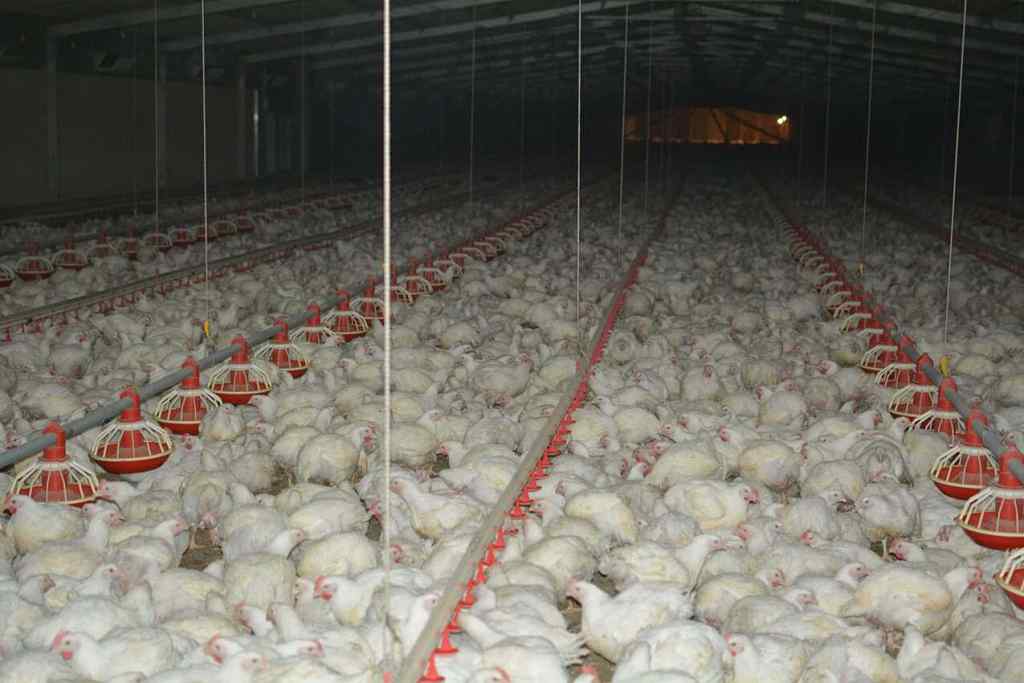
Most chicken meat found in supermarkets is produced intensively in large sheds with stocking rates of up to 20 chickens per square metre. The chickens never leave the shed and the build-up of faeces causes respiratory problems and skin to blister and burn. Foot problems are common. Image courtesy of Animal Liberation.
Chicken
The industry standard
The Model Code of Practice, the ‘conventional’ industry standard sets out
minimum allowable welfare conditions, which don’t specify free range. Birds
can be raised indoors for their whole lives, at up to 20 birds per square
metre, often in the tens of thousands. Continuous artificial lighting can
be used for 23 out of 24 hours (to encourage eating and growth).
These are some of the options that go above this standard.
Chicken brands to look out for
Australian Certified Organic (ACO)
Australian Certified Organic is one of six government-approved organic certifying bodies.
ACO mandates that chickens always have access to the outdoors during
daylight hours, no matter what their age.
ACO caps outdoor stocking rates at 2500 to 4800 birds per hectare (the
range depends on whether paddock rotation is used). In the shed, chickens
can be stocked at 12 birds per square metre, and artificial lighting is
capped at 16 hours per day, with at least eight hours of continuous dark
per night.
Inglewood Organic chickens are raised under the Australian Certified Organic standard. Image provided by Inglewood Organic.
Humane Choice and PROOF
Humane Choice and PROOF accredited brands offer higher welfare conditions than RSPCA Approved and FREPA, and are often as good as the ACO standard. Unfortunately they’re not always found in major supermarkets. One big difference is that Humane Choice only stipulates that birds be given access to the outdoors after 21 days, but stocking densities and artificial lighting standards are the same as the ACO standards. (At the time of writing, PROOF is awaiting assessment by the ACCC for its application for Certification Trade Mark.)
FREPA
FREPA
accredited free range chickens are only let outdoors when they’re ‘fully
feathered’. There’s no cap on the amount of chickens per metre in the
outdoors, and in the shed they are stocked at up to 15 birds per square
metre. There is also no specified limit on the amount of artificial light
used.
RSPCA Approved
doesn’t necessarily mean free range. This standard allows meat chickens to
be raised intensively in sheds with stocking densities of up to 17 birds
per square metre, and up to 20 hours per day of artificial lighting, bright
enough to encourage foraging and activity. These conditions don’t compare
well with the other standards we looked at.
However, Hope Bertram, RSPCA Australia’s Human Food Marketing Manager, told
CHOICE: “The most important thing to understand is that free range doesn’t
necessarily equal good welfare. A poorly run free-range system can be bad
for welfare; likewise, a well-run indoor system can give the animals
everything they need.”
In better news for RSPCA Approved chooks, producers are required to meet
standards for the provision and quality of the litter inside the sheds to
avoid skin burns from ammonia build up.
The RSPCA standard also requires perches and hay bales to encourage
chickens to be active and build muscle strength. While this is an
improvement on the Model Code of Practice conditions, it stipulates only
2.7 metres of perching per 1000 birds – that’s a big squeeze.
Confusingly for shoppers, the RSPCA Approved label for animals raised
outdoors is the same as that for animals raised in sheds. So if you’re
looking for free range meat, this isn’t the label to choose.
The outdoor standard includes stipulations about providing edible
vegetation and adequate protection. But the maximum outdoor stocking rate
is the same as the indoor one – 17 birds per square metre.
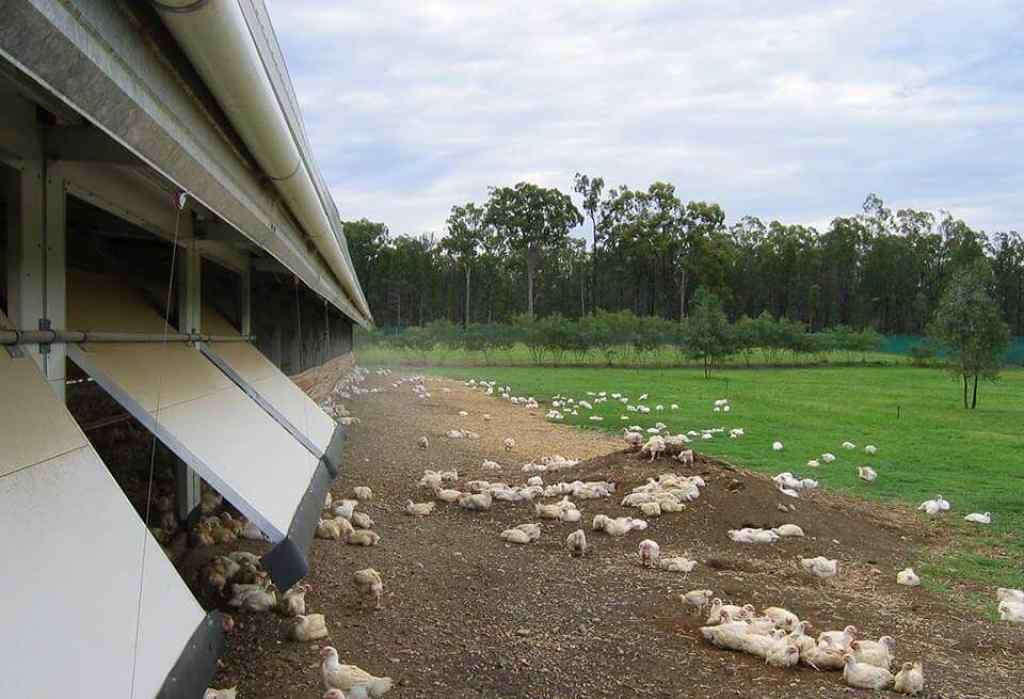
RSPCA Approved ‘Outdoor’ chickens are allowed outdoor access once they’re
“reasonably feathered” or 28 days old. The RSPCA says this is for welfare
reasons – “Birds are indoors until they’re fully feathered for their own
protection from the elements” – but since they’re slaughtered between five
and seven weeks old, they’ll still spend the bulk of their lives in the
shed.
Brands
Mt Barker Free Range Chicken
How are meat chickens raised?
Does the labelling on your meat tell the whole story?
Pigs in conventional indoor piggeries have a crowded life in group pens – the minimum floor area for a 100-kilogram pig is only .66m2, under the
model Code for Pigs. The same size grower pig in an RSPCA Approved
operation has 1.03m2.
Controversial sow stalls are still used by some producers for pregnant
sows. Designed to prevent aggression between pigs, they are restrictive
metal cages the length and width of the sow which don’t allow her to turn
around.
Until recently the sows could spend their whole 115-day pregnancy in a sow
stall. In July 2017, the industry’s Model Code of Practice for Animal Welfare:Pigs imposed restrictions meaning
that sows can only be confined in these for up to six weeks of their
pregnancy. Some producers are going further than this and certifying as “Gestation Stall Free”, meaning sows must not be confined for any longer than five days after mating.
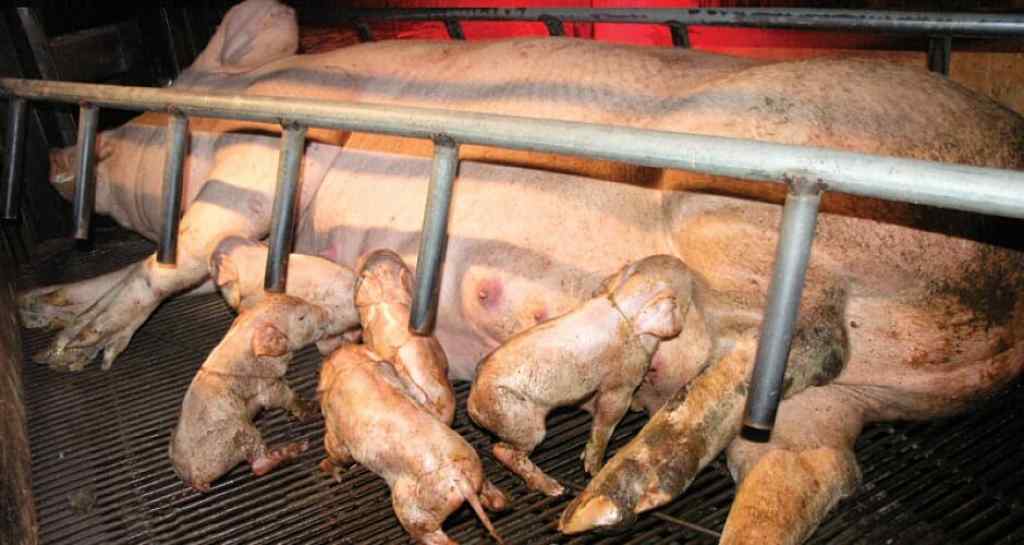
Less well known is that sows are routinely moved to narrow steel farrowing
(or gestation) crates to have the piglets, which separate them from their
young by a metal bar. Farrowing crates are designed to protect piglets from
being crushed by their mother, but they’re considered inhumane by some
because sows are confined in these for up to four weeks, only able to stand
up and lie down on metal floors.
Hilliard argues that the Sow Stall Free label is misleading. “What most
consumers don’t understand is that doesn’t mean the sow isn’t constrained
to a farrowing crate prior to and after birth for weeks.”
For instance, Coles Brand fresh pork has been sow stall free since 2014 – but farrowing crates are allowed.
A sow confined to a farrowing crate. These are routinely used in conventional piggeries to reduce the mortality of piglets. Image courtesy of Animals Australia.
Comparing the labels
Unless they’re creditably labelled as free range, all Australian pork products in Aldi and Woolworths have been bred and raised in sheds, likely with the use of farrowing crates and possibly sow stalls.
The label ‘Outdoor Bred: Raised Indoors on Straw’ means the adult breeding pigs live outdoors with shelters, and the piglets are bred outdoors. But after three weeks, or weaning, they’re moved indoors to group housing in sheds with straw bedding, and kept there until slaughter.
RSPCA Approved bred free range pigs are brought indoors after weaning but kept in large open sheds with straw.
Sows and piglets in an Australian Pork Limited certified ‘Outdoor bred: Raised Indoors on Straw’ breeder site. Upon weaning the grower pigs are moved to group housing in sheds with straw bedding where they remain until they reach their targeted liveweight. Image courtesy of Australian Pork Limited.
Free range pork labels
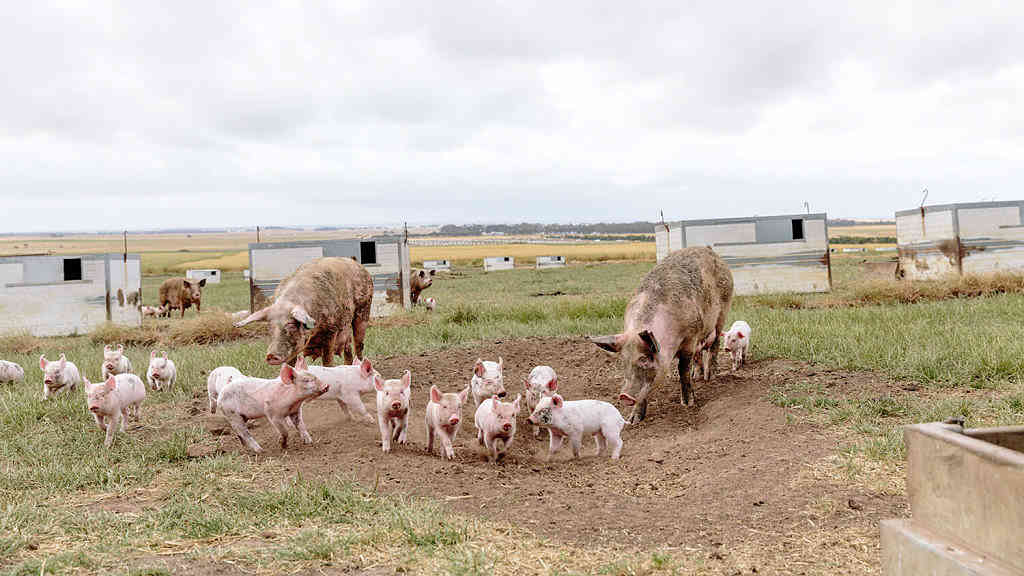
If you want your pork to have been born and raised outdoors (for their
whole life) avoid ‘bred free range’ and ‘outdoor bred’ labels and instead
look for products with one of these labels:
Humane Choice
Australian Certified organic
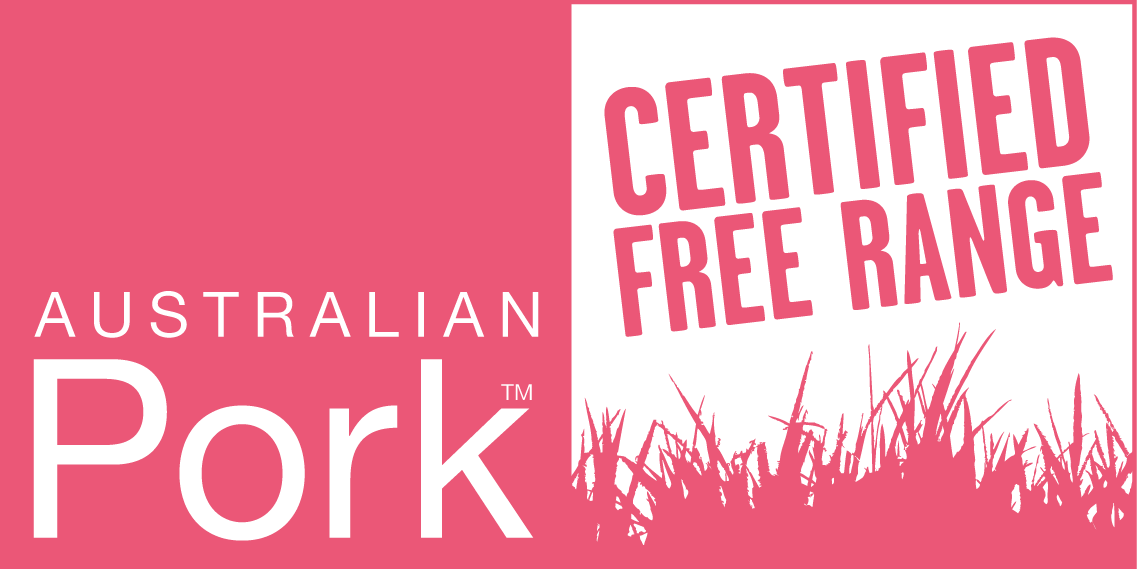
Australian Pork Certified Free Range
PROOF – Pasture Raised On Open Fields
Pigs raised under the Australian Certified Organic (ACO) standard are the
most likely to have been raised free range with high welfare conditions.
Unfortunately, certified organic pork is not listed as available from Coles
or Woolworths on their online shopping sites, and isn’t available at Aldi.
And if you’re looking to buy Humane Choice or PROOF accredited meat, at the
time of publishing we couldn’t find any on sale at Aldi, Coles or
Woolworths. (At the time of writing, PROOF is awaiting assessment by the ACCC for its application for Certification Trade Mark.)
RSPCA Approved does not guarantee ‘free range’
RSPCA Standards don’t require pigs to have access to an outdoor or range
area, but where they do have access, there are additional ‘outdoor’
standards. Yet the logo you’ll see on packages in store is the same for
either standard so it’s not possible to work out if the animal was raised
free range from this label.
RSPCA Approved ‘outdoor’ system standards allow for piglets to be moved to
sheds after weaning with ‘access to outdoors’.
At the time of writing the RSPCA told CHOICE that all the pig farms that
are currently in the RSPCA Approved Farming Scheme are raised to the RSPCA
outdoor standards.
Pork brands to look out for
Woolworths Macro Free Range Pork, Coles Free Range pork and Cleaver’s
Certified Free Range are Australian Pork Certified Free Range. According to
the standards, these pigs live outdoors always, with no use of indoor
sheds, sow stalls or farrowing crates.
Beef and lamb from feedlots
Feedlots, where lambs and cattle can be fattened before slaughter, are
environments in which they are confined in often dusty, hot conditions in
large numbers in yards, and fed a diet of pure grain. People object to them
because animals can suffer from heat stress, flies, the accumulation of
manure and conditions such as bovine respiratory disease.
How to avoid meat from feedlots
Marbled Wagyu beef production generally incorporates feedlotting.
Feedlots are ruled out for certified organic lamb and beef, and
certified grass-fed beef under the Pasturefed Cattle Assurance Scheme
(PCAS).
Woolworths’ ‘grass fed’ range is PCAS-certified not to use feedlots,
but Aldi’s grass-fed range isn’t. Aldi has said it will allow grain
supplements when weather conditions require this.
Can’t find what you want in the supermarkets?
If the shelves are bare of the cuts you’re seeking, let the retailer know,
and try ordering online. Sometimes supermarkets stock more certified organic and free range cuts online.
Seek out butchers that specialise in providing higher welfare meats where the provenance is known and verified. Ask about where the animal came from and if the butcher knows the farm or producer. The butcher who specialises in this field should be able to explain how the animal was raised differently to conventional conditions. Be wary of false claims of ‘free range’ that cannot be verified.
Ethical options for meat eaters
Avoid factory farmed chicken and pork products.
Avoid animals finished in feedlots.
Choose certified organic, PROOF or Humane Choice accredited labels.
Choose quality over quantity – consider weekly ‘meat free’ days, or
restrict meat to special occasions.
Eat secondary or less popular cuts to make use of the whole animal
and reduce waste.
For more than 60 years, we've been making a difference for Australian consumers. In that time, we've never taken ads or sponsorship.
Instead we're funded by members who value expert reviews and independent product testing.
With no self-interest behind our advice, you don't just buy smarter, you get the answers that you need.
You know without hesitation what's safe for you and your family. And our recent sunscreens test showed just how important it is to keep business claims in check.
So you'll never be alone when something goes wrong or a business treats you unfairly.