As a desire for convenience converges with a growing interest in premium products, the range of stocks on offer at the supermarket just keeps expanding.
Once upon a time, if you didn’t want to make your own stock, your only option was stock cubes. Then came powders, liquids, concentrates and, recently, bone broths.
With more types of stocks available now than ever before, it’s hard to know if one’s better than another. We compare concentrates, liquid stocks and bone broths to see how they differ.
Text-only accessible version
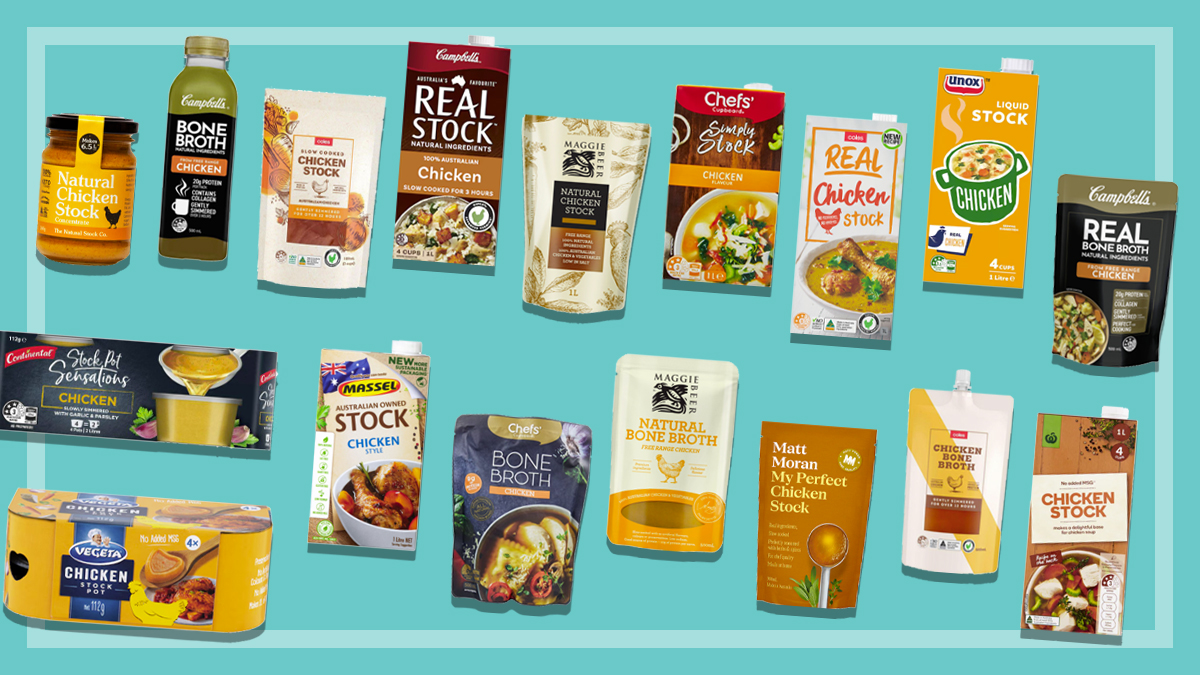
We looked at liquid chicken stocks, concentrates and bone broths from the major supermarkets to see how they vary in price, nutrition and ingredients. Here is a quick snapshot of what we found.
Cheapest liquid stock: Chef’s Cupboard (Aldi) Simply Stock: $0.18/100ml Most expensive liquid stock: Matt Moran My Perfect Chicken Stock: $1.18/100ml Lowest sodium liquid stock: Maggie Beer Natural Chicken stock 44mg/100 ml and $0.90/100ml Cheapest bone broth: Chef’s Cupboard (Aldi) Bone Broth Chicken $1.00/100ml Most expensive bone broth: Maggie Beer Natural Bone Broth $1.70/100ml Lowest sodium chicken stock concentrate: Natural Stock Co. Natural Chicken stock 211mg/100ml and $0.17/100ml Fewest additives: Coles Slow Cooked Chicken Stock – only salt and black peppercorns. Cost is $1.00/100ml Most additives: Woolworths Chicken Stock – includes lactic acid (270) and anticaking agent (551). Cost is $0.19/100ml Vegetarian option: Massel Stock Chicken Style. Made with no chicken at all.
We compared 17 bone broths and stocks in liquid and concentrate form, choosing products that were available at Coles, Woolworths and Aldi in June and July 2025.
Bone broths vs stocks
In recent years, bone broths have been added to the crowded stock section of supermarkets. We’ve seen products from premium brands such as Maggie Beer; national brands such as Campbells; and supermarket brands like Aldi and Coles.
So what’s the difference between a bone broth and a stock?
CHOICE home economist Fiona Mair says that while some of the ingredients can vary, it’s mainly the intended purpose that sets them apart.
Bone broths often claim to have nutritional and health benefits
“Bone broths are for heating and drinking, and they often claim to have nutritional and health benefits, which come from the collagen, gelatine, amino acids, and minerals they contain,” she says.
“On the other hand, stocks are used as a base in soups, risottos, sauces, gravies and casseroles.”
Bone broths can still be used as a stock substitute, though.
Looking at the products in our comparison – all of them found in the stock section of the supermarket – a few things stood out about the ingredients.
Both meat and bones can be used in the production of both bone broths and stocks, but broths tend to more often be made from just the bones.
Additives in the bone broths are minimal and may include herbs, vegetables and apple cider vinegar (used to help extract nutrients from bones). You might also find collagen peptides and gelatin.
Both meat and bones can be used in the production of both bone broths and stocks, but broths tend to more often be made from just the bones
Of the bone broths we looked at, the Aldi Chef’s Cupboard product had the most unusual ingredients, including goji berries, Chinese yam, shitake mushrooms, milk vetch root and polygonatum (also known as Solomon’s seal). In contrast, stocks are more likely to include flavour enhancers and powders, as well as ingredients such as thickeners and colours.
Some of the stocks we looked at included reconstituted stock, which means that stock concentrates were diluted with water in order to produce them. If purchasing these products, consider whether you might be better off buying stock powders or cubes and adding the water yourself.
We also found that broths are, on average, lower in sodium than stocks.
Cost comparisons
Cost is another obvious difference. Looking at the products we compared, liquid stocks were much cheaper than the bone broths.
You’ll pay on average just $0.81/100ml for the liquid stocks and concentrates in our comparison.
The bone broths we looked at cost 77% more on average: $1.44/100ml.
When comparing the price per 100ml, the cheapest product in our comparison was The Natural Stock Co Chicken Stock Concentrate. A 160g jar will set you back $10.95 but makes 6.5L, meaning it will cost just $0.17/100ml.
At the other end of the scale, Maggie Beer’s Natural Chicken Free Range Bone Broth costs $8.50 for a 500ml pouch or $1.70/100ml.
Expensive vs cheap stock
While stocks tend to be cheaper overall than bone broths, there’s still a wide range of prices.
Liquid stocks can cost as little as $0.18/100ml (Aldi’s Chef’s Cupboard Chicken Flavour Liquid Stock 1L), all the way up to $1.18/100ml (Matt Moran’s My Perfect Chicken Stock 500ml).
Also near the top of the list for price were the Coles Slow Cooked Chicken Stock ($1/100ml) and the Maggie Beer Natural Chicken Stock ($0.90/100ml).
So what’s the difference? While the Aldi stock is inexpensive, it contains additives such as maltodextrin and vegetable protein extract. In fact, four of the cheapest five stocks contain maltodextrin. In contrast, the Matt Moran product has no additives of this kind.
Fiona says when buying a stock, look for a product that contains mostly natural ingredients, such as meat bones, vegetables, herbs, water and salt.
“A good chicken stock should smell like chicken, have a balanced flavour and not be too salty,” she says. “It should have a smooth, slightly silky mouthfeel and should be clear, not cloudy. A natural golden colour is also a sign of quality.”
The Natural Stock Co Chicken Stock Concentrate 160g
Bone broths
Campbells Bone Broth 500ml (screw top bottle)
Campbells Real Bone Broth 500ml (pouch)
Coles Chicken Bone Broth 500ml
Maggie Beer Natural Bone Broth 500ml
Chef’s Cupboard Chicken Bone Broth 500ml (Aldi)
Are concentrated stocks any good?
With many of the liquid stocks in our comparison you’re essentially paying for (and carrying home) a lot of water. So why not buy a concentrate? They tend to be cheaper, too.
The Continental Stock Pot Sensations works out to be just $0.23 per 100ml, the Natural Stock Company product costs $0.17/100ml, and the Vegeta Chicken Stock Pots are $0.20/100ml.
“With a concentrated stock, you have control of how much you want to make or add to your recipe,” says Fiona.
“It is much more economical in the long run, has less packaging and reduces the weight in your shopping bag. They’ll also take up less space in your pantry or fridge.”
Sodium and additives in broths and stocks
The bone broths we looked at tended to have fewer additives than the stocks and concentrates, and most seemed to align with broth’s reputation as a ‘wellness’ product.
On the other hand, the stocks we compared contained a wide range of sweeteners, sugars, flavour enhancers, thickeners and texture agents, stabilisers and preservatives. Some contained added fats and oils, and dehydrated and powdered ingredients were also present.
While none of these are inherently bad, if you’re trying to avoid too many additives or processed ingredients, be careful when buying these products.
Sodium is another big differentiator. Liquid stocks have approximately 48% more sodium on average than bone broths (298mg versus 182mg).
However, sodium can vary widely in the liquid stocks we compared: The Campbell’s Real Chicken stock contained 447mg per 100ml, while Maggie Beer’s Natural Chicken Stock was lowest in sodium, just 44mg per 100ml.
Making your own stock
While convenience is an important consideration for many of us, Fiona says it’s very simple to make your own chicken stock. You don’t even need to strictly follow a recipe.
“Keep a plastic bag in the freezer to add any vegetable peels or leftover bones from dinner. When you’re ready to make a stock, add them to the pot,” she says.
If you’d prefer a bit more guidance, Fiona’s recipe below is an easy one to start with.
Fiona's chicken stock recipe
Fiona’s chicken stock recipe
Ingredients
1kg chicken wings
3 litres water
1 tablespoon salt
Method
Place ingredients in a large 4-litre saucepan.
Bring to the boil, then reduce heat and simmer for roughly 2–4 hours (the longer the better).
Strain the stock using a fine sieve, and discard the chicken wings.
Stock can be used immediately or poured into containers and frozen for later.
Tips
If using stock straight away, let it sit for a few minutes to allow the fat to come to the top, which you can then spoon off.
If using stock from frozen, scrape off and discard the layer of fat that will be sitting on top. This can be done before defrosting.
Broths and stocks comparison tables
Text-only accessible version
Chicken stock (liquid)
Chef’s Cupboard Simply Stock Real Chicken Flavour 1L
Cost per 100mL* ($): 0.18
Sodium (mg/100mL): 352
Packaging: Carton
Coles Real Chicken Stock Cost per 100mL* ($): 0.19 Sodium (mg/100mL): 334
Packaging: Carton
Margaret Rafferty joined CHOICE in 2018 as a Content editor and since then has filled the roles of Commissioning editor, Managing editor and now Editorial consultant. Margaret has written on a wide variety of topics and enjoys making complex subjects easy to understand.
With over 20 years of media experience, Margaret brings a strong storytelling background to CHOICE. She works closely with people across the organisation to help tell stories that make a positive difference to people.
Margaret is passionate about uncovering bad practices and helping Australians understand how to avoid falling victim to shonky products and services.
Find Margaret on LinkedIn.
Margaret Rafferty joined CHOICE in 2018 as a Content editor and since then has filled the roles of Commissioning editor, Managing editor and now Editorial consultant. Margaret has written on a wide variety of topics and enjoys making complex subjects easy to understand.
With over 20 years of media experience, Margaret brings a strong storytelling background to CHOICE. She works closely with people across the organisation to help tell stories that make a positive difference to people.
Margaret is passionate about uncovering bad practices and helping Australians understand how to avoid falling victim to shonky products and services.
Find Margaret on LinkedIn.
For more than 60 years, we've been making a difference for Australian consumers. In that time, we've never taken ads or sponsorship.
Instead we're funded by members who value expert reviews and independent product testing.
With no self-interest behind our advice, you don't just buy smarter, you get the answers that you need.
You know without hesitation what's safe for you and your family. And our recent sunscreens test showed just how important it is to keep business claims in check.
So you'll never be alone when something goes wrong or a business treats you unfairly.