Fibre to the node (FTTN)
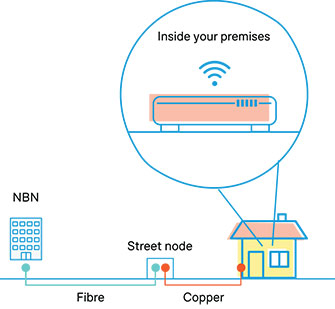
Fibre to the node (FTTN) is the most common of the so-called copper NBN technologies. Fibre optic cable is run from the point of interconnect (POI) to a node (usually a green box in the street) in your neighbourhood.
From the node, twisted pair copper wiring makes the last leg of the journey to your house – the same kind of cabling used for pre-NBN landline phone services and ADSL (Asymmetric Digital Subscriber Line).
Once there, it uses the pre-existing phone cables in your home’s walls. Inside your home, it looks similar to an ADSL connection – a modem plugs directly into a wall phone outlet.
Although it uses the same cables and wall sockets as ADSL, FTTN employs the far-faster VDSL (Very High-Speed Digital Subscriber Line) technology. FTTN’s use of nodes means less copper than ADSL, which uses copper to connect a premises to a Telstra exchange building.
According to NBN Co, the average distance between an FTTN-connected premises and the node is 450 metres. Two thirds of premises are within 400 metres. The average distance between ADSL connections and the exchange was about two kilometres. While FTTN is definitely hampered by its last-leg copper wires, the amount of copper compared to ADSL is undeniably less.
Fibre to the building (FTTB)
Fibre to the building (sometimes called fibre to the basement) is like FTTN, so much so that NBN Co lumps the two together in its corporate plan.
This time, fibre goes all the way from the POI to the communications room of an apartment block or other multidwelling unit (MDU). From there, the building’s pre-existing wiring does the rest.
This usually means less copper wiring is used than with FTTN. However, if your apartment building is old, replacing it with newer wires can be difficult because you may have to negotiate with strata for any rewiring that happens between your apartment and your building’s telco room.
Fibre to the curb (FTTC)
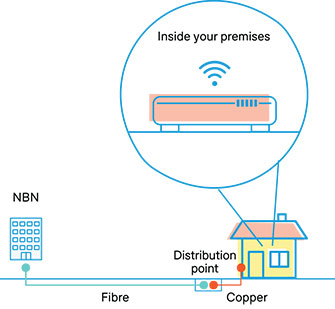
Spelled “curb” (not kerb) because it’s an international standard, FTTC is like FTTN, but instead of a node the copper wiring starts at a telco pit (aka distribution point unit) much closer to your house. Instead of hundreds of metres, the copper cabling is often under 100 metres.
As such, it’s much faster than FTTN. It also has the ability to be upgraded using G.fast technology, which can potentially handle speeds far greater than what NBN plans currently offer.
Fibre to the premises (FTTP)
FTTP is the fastest NBN connection technology, taking fibre all the way to your home or business.
A large fibre cable goes from the POI to a (usually beige) fibre node somewhere in your neighbourhood, which splits the signal across smaller fibre cables to finish the journey.
Few older premises are still being connected to FTTP. However, some new developments are getting it.
Hybrid fibre coaxial (HFC)
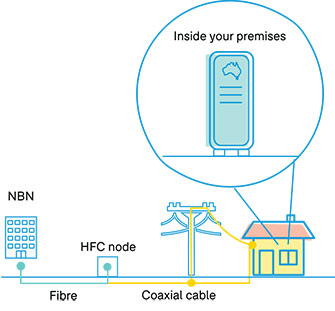
HFC, also known as cable internet, uses fibre optic cable most of the way to your house, after which coaxial cabling finishes the journey.
This differs to FTTB, FTTN and FTTC because coaxial cabling is a shielded copper technology. As such, it can transfer data more quickly and over longer distances without signal degradation.
HFC usually has a much shorter distance between you and where the fibre cabling terminates when compared to FTTN.
Fixed wireless
NBN fixed wireless is used in rural and regional areas where premises are too spread out for fixed-line broadband to meet NBN’s cost requirements.
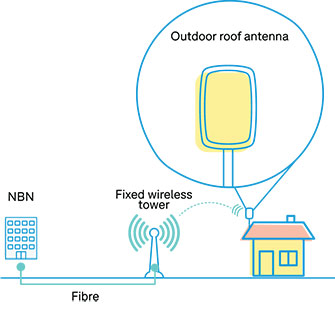
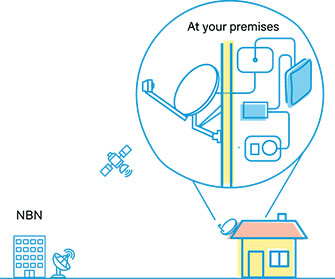
Fibre optic cable runs to a fixed wireless tower, which transmits a signal via 4G to an antenna on top of your house.
This technology is one of the slowest, and has had many reported speed and congestion problems during peak hours.
Sky Muster satellite
Satellite NBN connections happen via the two Sky Muster satellites, both of which are built and owned by NBN Co.
This connection technology is reserved for the most remote locations, or when sight-lines for fixed wireless signals are blocked by obstacles such as hills or trees.
High-capacity fibre optic cables run to several ground stations which communicate with the satellites. The two satellites are locked in geostationary orbit about 36,000km away from Earth.
That means sending out any signal over the internet and getting a response (such as clicking a link and having a web page load) requires a signal journey of over 144,000km because it has to make the two-way journey into orbit and back twice.
It’s the slowest NBN technology, both in megabits per second and latency. But as far as satellite broadband goes, it’s among the best in the world.
Given the distance a satellite signal has to travel, it’s understandable that it can’t be as fast as a fixed-line technology.